
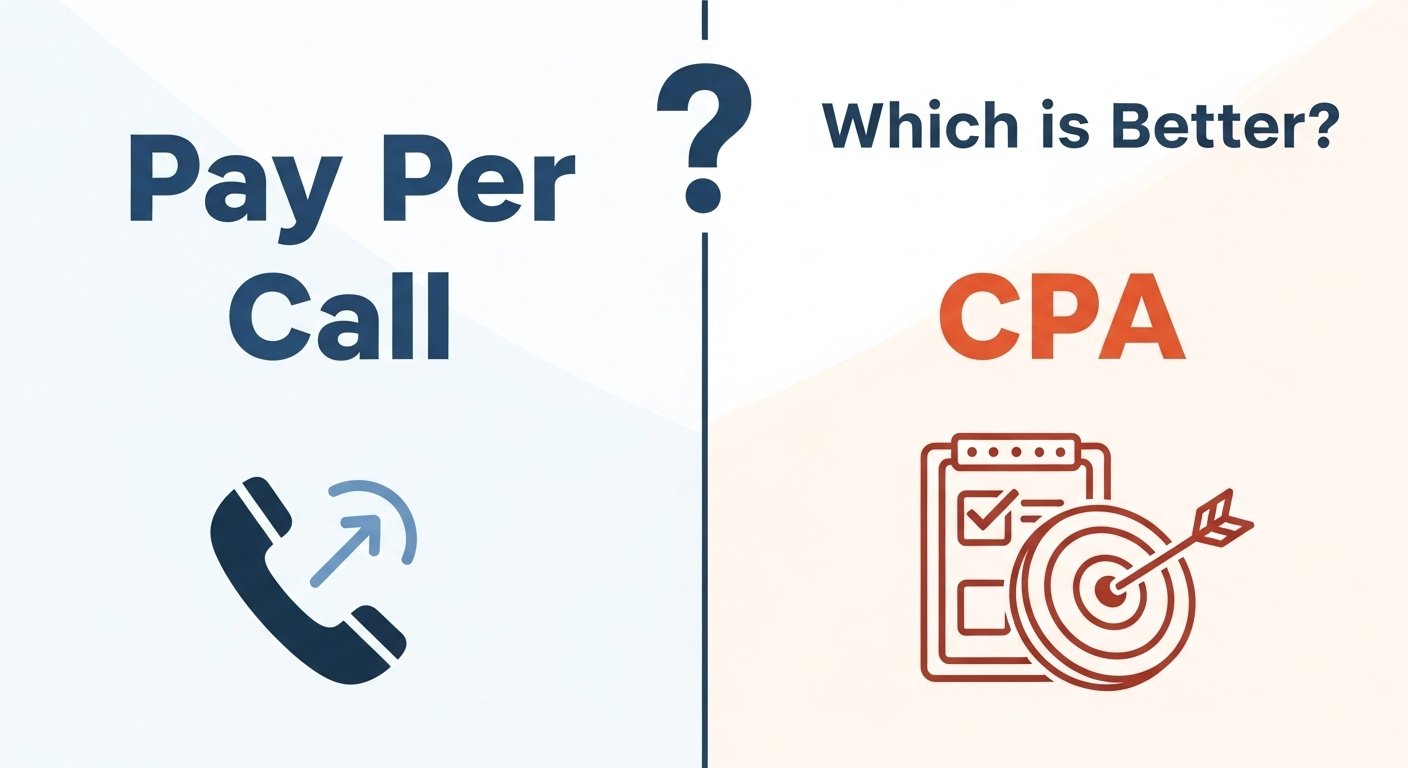
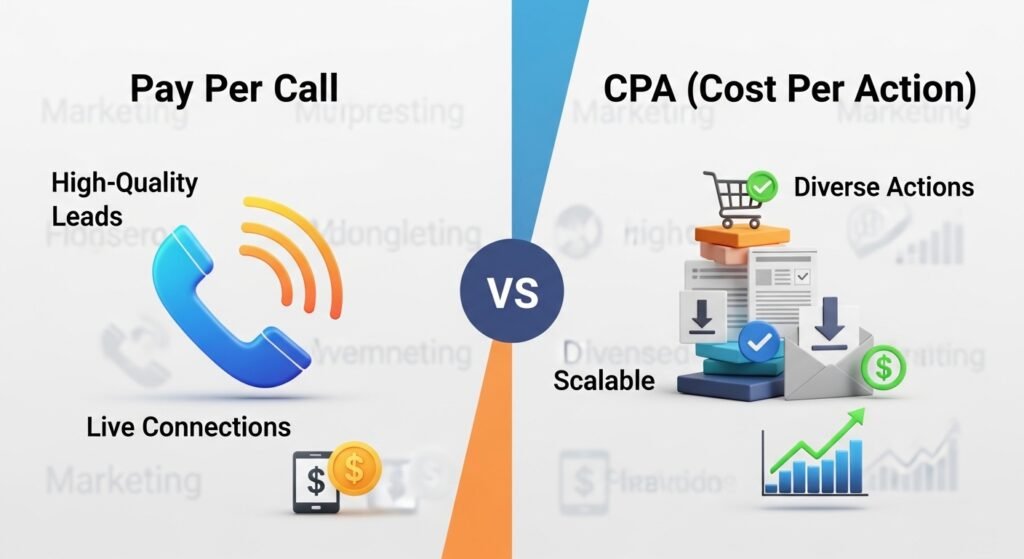
People love comparing Pay Per Call and CPA like one is clearly better.
Usually the answer depends on what kind of traffic you’re actually running. Most don’t check that part.
What people assume.
CPA is easier. Lower payouts, less risk.
Pay Per Call is harder but pays more.
Sounds clean. Not how it plays out.
What actually happens.
CPA hides bad traffic.
You can push low-intent clicks, still get a few conversions, and think things are working.
Pay Per Call exposes everything.
If your traffic is weak, calls don’t last. No duration, no payout. End of story.
How the mechanics differ.
CPA flow is stretched.
User clicks → lands → reads → maybe fills a form → maybe converts.
A lot of drop-off points.
You’re betting on percentages.
Call flow is compressed.
User calls → talks → decision happens live.
No buffer. No delay.
Either the intent is real, or it isn’t.
Where things break.
CPA breaks quietly.
Bad traffic can still produce some conversions.
You scale thinking you’re profitable, then margins disappear.
Also, a lot of “conversions” are low-quality leads.
They don’t turn into real customers, but you still get paid once.
Pay Per Call breaks loudly.
Low-intent traffic doesn’t even pass the duration filter.
You see the problem immediately.
But there’s another issue.
If routing or IVR is poorly set, even good calls get wasted.
So you can have strong traffic and still lose money.
This is where a lot of people underestimate the backend. The difference between a profitable campaign and a dead one is often how calls are handled after they’re generated. You can see how structured call flow setups work in practice at https://oradiant.com/.
There’s also a control issue.
With CPA, once the lead is submitted, it’s out of your hands.
With calls, routing, timing, and agent quality directly affect your results.
More upside, but more things that can go wrong.
Practical takeaway.
If your traffic is inconsistent or broad, CPA is safer.
It absorbs mistakes.
If you can generate high-intent users consistently, pay per call wins.
Higher payouts, faster feedback, cleaner scaling.
But only if the backend is tight.
Otherwise you’re just paying to listen to people hang up.